Fallen angels
Soul Guardian: A Hellishly Cozy FantasyFallen angels occupy the unstable border between Heaven and Hell, carrying the marks of celestial conflict while remaining capable of withdrawal, reinvention, and refusal. Their condition is associated with physical injury, altered loyalties, contested belonging, and uncertain jurisdiction. The book’s fallen angels are therefore not simply monsters or former servants of Heaven: they are survivors negotiating what remains after a sacred war has ended.
Origins in War and the Mark of Fallenness
Maharet Flameheart provides the clearest physical history of a fallen angel. Her scars were inflicted during the battle for Heaven, when she was serving as air support and a seraph came up behind her and clipped her wings. The fall itself caused severe injury: she struck the ground with such force that she remained unconscious until the war was almost over. Her raised scar tissue makes the Fall visible on the body, turning celestial history into a permanent personal record rather than an abstract theological event.
Her military past also complicates the boundary between the former enemies. Bael-Sharoth served in the Infernal Infantry, while Maharet fought on Heaven’s side before becoming fallen. Their histories place them on opposing sides of the same war, yet the disclosure of those histories becomes part of their intimate relationship. Fallenness consequently marks both injury and transition: it records where a being stood, but does not permanently determine where that being may stand afterward.
Institutions, Duties, and New Allegiances
The book contrasts fallen or war-shaped celestial identities with the institutional expectations of Heaven. At the Arms of the Angels Adoption Agency, Zephyr defends a form of angelic service centered on children rather than battle. When Gabriel questions whether this work is more important than his duties to Heaven, Zephyr points to photographs of boys and girls placed with new families and insists that this is how he has chosen to serve the creator. He rejects the assumption that angelic legitimacy requires a flaming sword, arguing that some angels possess softer skills.
Zephyr’s position is defined by his relationship to the aftermath of war. He tells Gabriel that he has not forgotten his past, but that he moved on after the war ended. This distinction matters because it treats memory and allegiance as separable: a fallen or war-marked celestial being may retain knowledge of the past without allowing the past to dictate every present obligation. The adoption agency becomes an alternative institution of angelic purpose, one organized around second chances rather than combat.
Exile, Possession, and the Refusal of Hell
Ganon-Sharoth shows another route through the problem of celestial and infernal identity. While possessing a human body, he has arranged a life separated from his former existence. The body limits him materially, since a demon possessing a human form is described as essentially powerless, but it also enables a clean break from the life he once knew. He explains that he left because he did not want Bael-Sharoth to be corrupted as well, presenting departure as both self-denial and an attempt at protection.
Ganon’s decision is more radical than a change of assignment. He declares that he will not go to Hell because he has forsaken it, and he condemns eternal damnation for crimes the demons never committed. His refusal exposes the political dimension of infernal identity: belonging to Hell is not portrayed as an unavoidable essence but as a condition that can be rejected, even when rejection leaves the individual without a secure destination. His possession of a human body thus becomes a precarious form of alternative existence, neither a return to Heaven nor an acceptance of Hell.
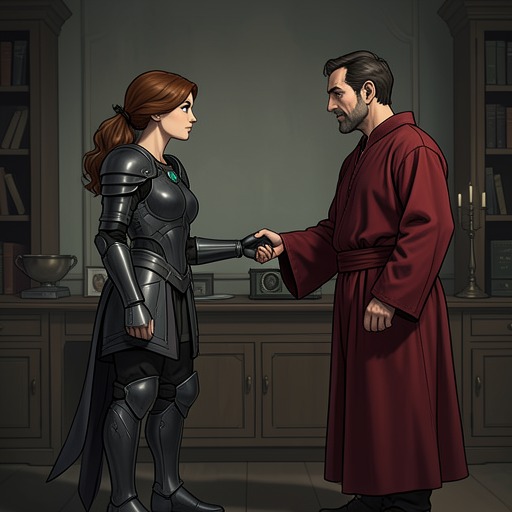
Maharet’s own disclosure follows a different pattern. She tells Bael-Sharoth directly that she is a fallen angel, expecting the secret to alter the terms of their future together. Bael already knows her history, however, and his lack of surprise prevents the revelation from becoming a rupture between them. The scene makes fallenness a concealed fact that can nevertheless be integrated into intimacy. Her identity is serious, but it is not treated as a final verdict on her character or on the life she and Bael are trying to build.
Legal and Cosmic Consequences
The status of fallen angels is also defined by exclusion from established realms. Gabriel’s death demonstrates the harshest version of this condition. Bael-Sharoth banishes him from the infernal realm and all associated territories before killing him with a holy weapon. Gabriel’s soul is then refused entry into Heaven, Hell, and even purgatory, which lies on the outer fringes of the infernal realm. The result is a form of absolute jurisdictional homelessness: he belongs nowhere, and his unprotected contact with the void causes his soul to unravel.
This fate distinguishes ordinary death from the metaphysical consequences of expulsion. Gabriel is not merely killed; he is removed from every recognized place of settlement. The fallen angel becomes an example of what happens when allegiance, law, and territory are severed at once. His punishment turns fallenness into an ontological danger, because the space between dimensions offers no stable refuge for a being excluded by both major powers.
At the same time, the book refuses to make Heaven’s authority unlimited. When celestial forces confront Bael during his attempt to return to his family, he reminds them that he has defeated Gabriel, Metatron, and the Devil. He presents himself as a warrior formed through the front lines and the pits, his skin covered with scars from the journey, and declares that his desire to return home is stronger than the opposing faith. The encounter shows that identities forged by war can resist institutional command when family allegiance becomes more important than factional obedience.
Narrative Significance
Fallen angels give the book a vocabulary for lives that cannot be reduced to their original classification. Maharet’s wounds, Zephyr’s adoption work, Ganon-Sharoth’s renunciation of Hell, and Gabriel’s final exclusion represent four distinct outcomes of celestial conflict: survival, redirection, refusal, and annihilating exile. Together they show that the end of war does not restore a simple moral order. It leaves beings to determine whether inherited allegiance, remembered violence, or chosen relationships will govern the future.
Their stories also connect supernatural identity to found family and second chances. Zephyr’s work explicitly grants children new homes; Maharet’s relationship with Bael crosses former battle lines; and Ganon’s abandonment of Hell is motivated by his wish to prevent his brother’s corruption. Against these examples, Gabriel’s fate appears as the terminal form of an identity that cannot move beyond revenge and institutional conflict. Fallen angels therefore embody the book’s broader argument that origin matters, but chosen bonds and chosen service can matter more.